Headline: Does Cracking Your Knuckles Actually Cause Arthritis? Here’s What That “Pop” Really Means 🦴💥
If you’ve ever cracked your knuckles, knees, or neck in front of someone, you’ve probably heard it:
“Stop doing that, you’ll give yourself arthritis!”
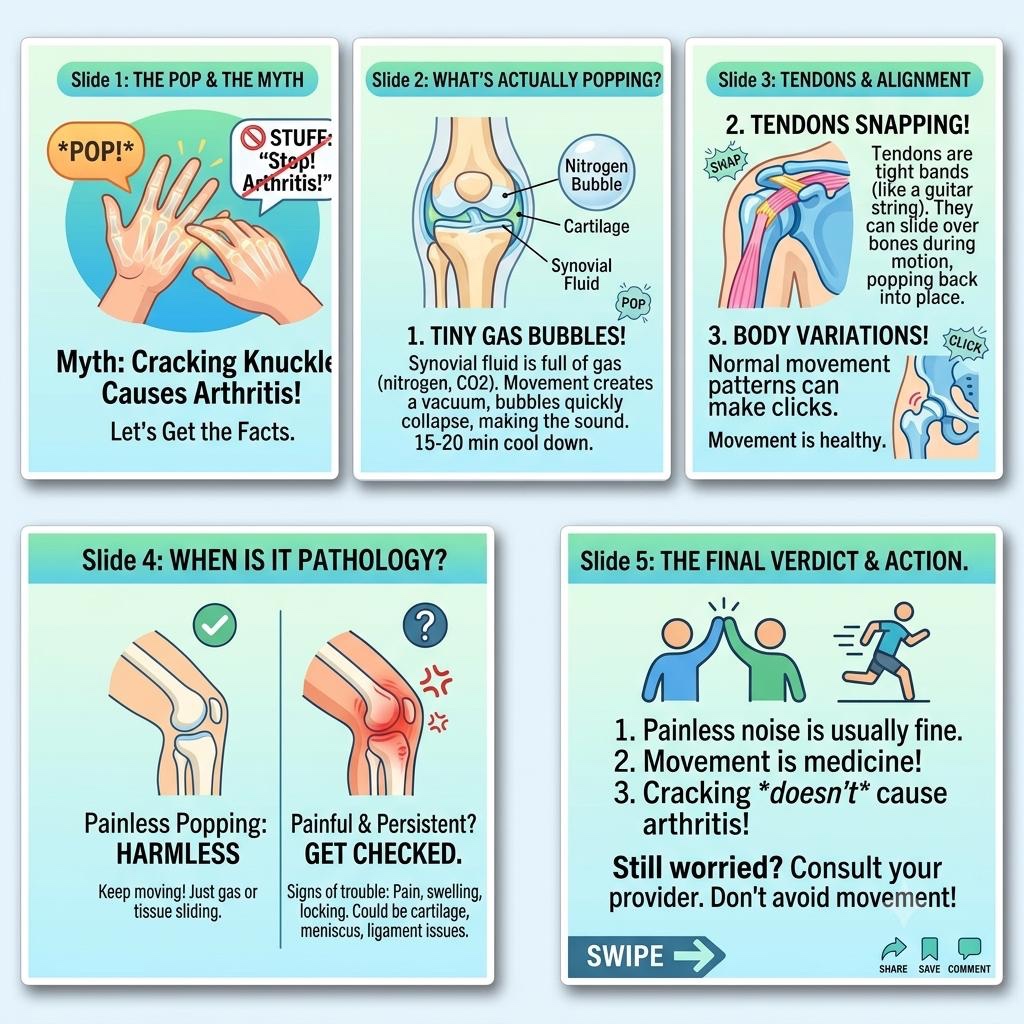
It’s one of the most widespread health myths around. But what is actually happening when your joints make noise? Let’s bust the myth and break down the science.
The Short Answer: No, It Doesn’t Cause Arthritis
Decades of medical research—including studies following people who cracked their knuckles on one hand for over 50 years—show no direct link between habitual cracking and osteoarthritis.
So where does that satisfying pop actually come from?
3 Harmless Reasons Your Joints Make Noise
* Tiny Gas Bubbles (Cavitation)
Your joints are surrounded by a protective lubricating fluid called synovial fluid. When you stretch or bend a joint, you create a slight vacuum. Microscopic bubbles of nitrogen and carbon dioxide form and rapidly collapse, producing that familiar 'pop.' Once popped, it takes about 15–20 minutes for the gases to dissolve back into the fluid before you can pop it again.
* Tendons & Ligaments Shifting
Think of a guitar string gently plucking. As a joint moves through its full range of motion, tendons or ligaments can slide over small bony ridges and snap cleanly back into place. This is very common in the knees, hips, and ankles.
* Natural Variations in Joint Alignment
Every body moves slightly differently. Subtle shifts in posture or normal movement patterns can create benign clicks and thuds that come and go throughout the day.
The Golden Rule: Noise vs. Pain
Here is a simple way to know whether to worry:
* Painless clicks, pops, or snaps?
👉 Normal & harmless. Movement is healthy, keeps your joints lubricated, and does not need to be avoided just because it makes sound.
* Noise accompanied by pain, swelling, or a feeling of 'locking/catching'?
👉 Time to get checked. If clicking happens alongside discomfort, localized heat, or instability, it could signal a ligament issue, cartilage wear, or a meniscus tear that needs proper evaluation.
Quick Takeaway
Movement is medicine, and a noisy joint isn't automatically a damaged joint. Keep moving, stay active, and don't panic over harmless clicks!
Has a noisy joint ever worried you? Drop your questions below! 👇
#jointHealth #Orthopedics #HealthMyths #HealthyLiving #MobilityMatters #BoneHealth
If you’ve ever cracked your knuckles, knees, or neck in front of someone, you’ve probably heard it:
“Stop doing that, you’ll give yourself arthritis!”
It’s one of the most widespread health myths around. But what is actually happening when your joints make noise? Let’s bust the myth and break down the science.
The Short Answer: No, It Doesn’t Cause Arthritis
Decades of medical research—including studies following people who cracked their knuckles on one hand for over 50 years—show no direct link between habitual cracking and osteoarthritis.
So where does that satisfying pop actually come from?
3 Harmless Reasons Your Joints Make Noise
* Tiny Gas Bubbles (Cavitation)
Your joints are surrounded by a protective lubricating fluid called synovial fluid. When you stretch or bend a joint, you create a slight vacuum. Microscopic bubbles of nitrogen and carbon dioxide form and rapidly collapse, producing that familiar 'pop.' Once popped, it takes about 15–20 minutes for the gases to dissolve back into the fluid before you can pop it again.
* Tendons & Ligaments Shifting
Think of a guitar string gently plucking. As a joint moves through its full range of motion, tendons or ligaments can slide over small bony ridges and snap cleanly back into place. This is very common in the knees, hips, and ankles.
* Natural Variations in Joint Alignment
Every body moves slightly differently. Subtle shifts in posture or normal movement patterns can create benign clicks and thuds that come and go throughout the day.
The Golden Rule: Noise vs. Pain
Here is a simple way to know whether to worry:
* Painless clicks, pops, or snaps?
👉 Normal & harmless. Movement is healthy, keeps your joints lubricated, and does not need to be avoided just because it makes sound.
* Noise accompanied by pain, swelling, or a feeling of 'locking/catching'?
👉 Time to get checked. If clicking happens alongside discomfort, localized heat, or instability, it could signal a ligament issue, cartilage wear, or a meniscus tear that needs proper evaluation.
Quick Takeaway
Movement is medicine, and a noisy joint isn't automatically a damaged joint. Keep moving, stay active, and don't panic over harmless clicks!
Has a noisy joint ever worried you? Drop your questions below! 👇
#jointHealth #Orthopedics #HealthMyths #HealthyLiving #MobilityMatters #BoneHealth
Keywords