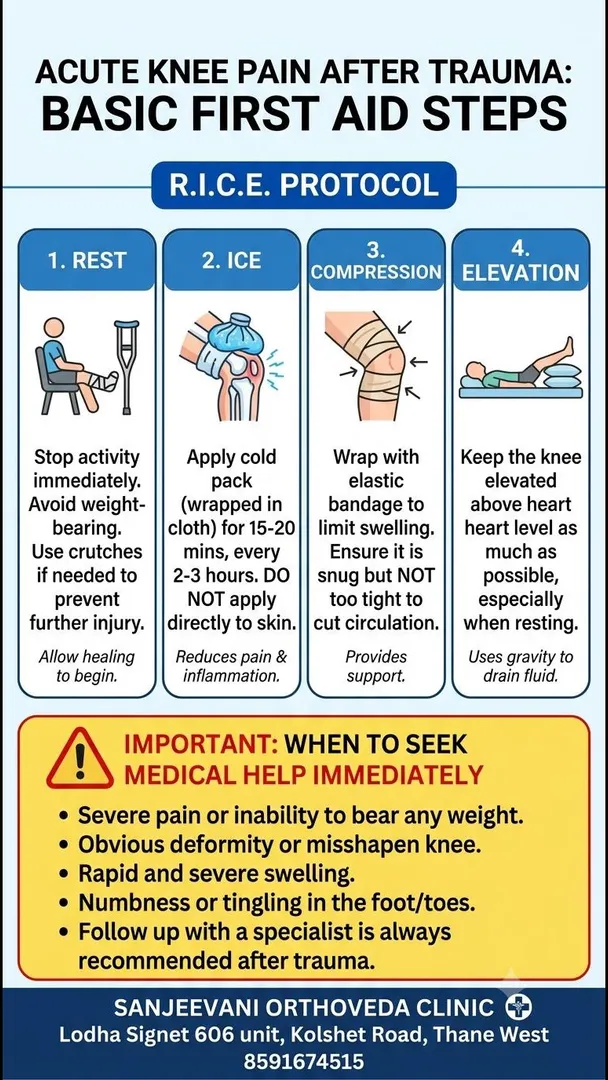
* REST (R): Immediately stop any physical activity and rest the injured knee. Avoid walking or putting any weight on the leg to prevent further structural damage to the ligaments, meniscus, or bone.
* ICE (I): Apply an ice pack or a bag of frozen vegetables wrapped in a thin towel to the painful area for 15 to 20 minutes every 2 to 3 hours during the first 24 to 48 hours. Never apply ice directly to the skin, as it can cause tissue damage. Cold therapy helps reduce acute inflammation and numbs sharp pain.
* COMPRESSION (C): Gently wrap the knee with an elastic compression bandage, starting from below the knee and wrapping upward. This helps minimize internal swelling, but ensure the bandage is snug without cutting off circulation or causing numbness, tingling, or increased pain.
* ELEVATION (E): Keep the leg elevated above the level of the heart as much as possible using pillows. Elevation uses gravity to help drain fluid away from the injury site and significantly reduces swelling.
* AVOID HARM (Hana): Steer clear of the 'H.A.R.M.' factors during the initial phase—no Heat (heating pads, hot showers, or balms), no Alcohol (which increases blood flow and swelling), no Running or weight-bearing, and no Massage, which can aggravate acute trauma.
* OVER-THE-COUNTER PAIN RELIEF: If needed and medically safe for the individual, basic analgesics like paracetamol can be used for initial pain management, avoiding self-prescribed strong anti-inflammatories without consulting a physician.
* WHEN TO SEEK IMMEDIATE MEDICAL ATTENTION: Go to an emergency center or orthopedic specialist immediately if you notice an obvious bone deformity, an inability to bear any weight for four steps, a 'locking' sensation where the knee gets stuck, severe swelling that appears rapidly within minutes, or numbness and a cold foot.
For a professional clinical evaluation, precise diagnosis, and specialized trauma care, you can consult with us at:
Sanjeevani Orthoveda Clinic
Unit 606, Lodha Signet, Kolshet Road, Thane West
Contact: 8591674515
* ICE (I): Apply an ice pack or a bag of frozen vegetables wrapped in a thin towel to the painful area for 15 to 20 minutes every 2 to 3 hours during the first 24 to 48 hours. Never apply ice directly to the skin, as it can cause tissue damage. Cold therapy helps reduce acute inflammation and numbs sharp pain.
* COMPRESSION (C): Gently wrap the knee with an elastic compression bandage, starting from below the knee and wrapping upward. This helps minimize internal swelling, but ensure the bandage is snug without cutting off circulation or causing numbness, tingling, or increased pain.
* ELEVATION (E): Keep the leg elevated above the level of the heart as much as possible using pillows. Elevation uses gravity to help drain fluid away from the injury site and significantly reduces swelling.
* AVOID HARM (Hana): Steer clear of the 'H.A.R.M.' factors during the initial phase—no Heat (heating pads, hot showers, or balms), no Alcohol (which increases blood flow and swelling), no Running or weight-bearing, and no Massage, which can aggravate acute trauma.
* OVER-THE-COUNTER PAIN RELIEF: If needed and medically safe for the individual, basic analgesics like paracetamol can be used for initial pain management, avoiding self-prescribed strong anti-inflammatories without consulting a physician.
* WHEN TO SEEK IMMEDIATE MEDICAL ATTENTION: Go to an emergency center or orthopedic specialist immediately if you notice an obvious bone deformity, an inability to bear any weight for four steps, a 'locking' sensation where the knee gets stuck, severe swelling that appears rapidly within minutes, or numbness and a cold foot.
For a professional clinical evaluation, precise diagnosis, and specialized trauma care, you can consult with us at:
Sanjeevani Orthoveda Clinic
Unit 606, Lodha Signet, Kolshet Road, Thane West
Contact: 8591674515
Keywords